
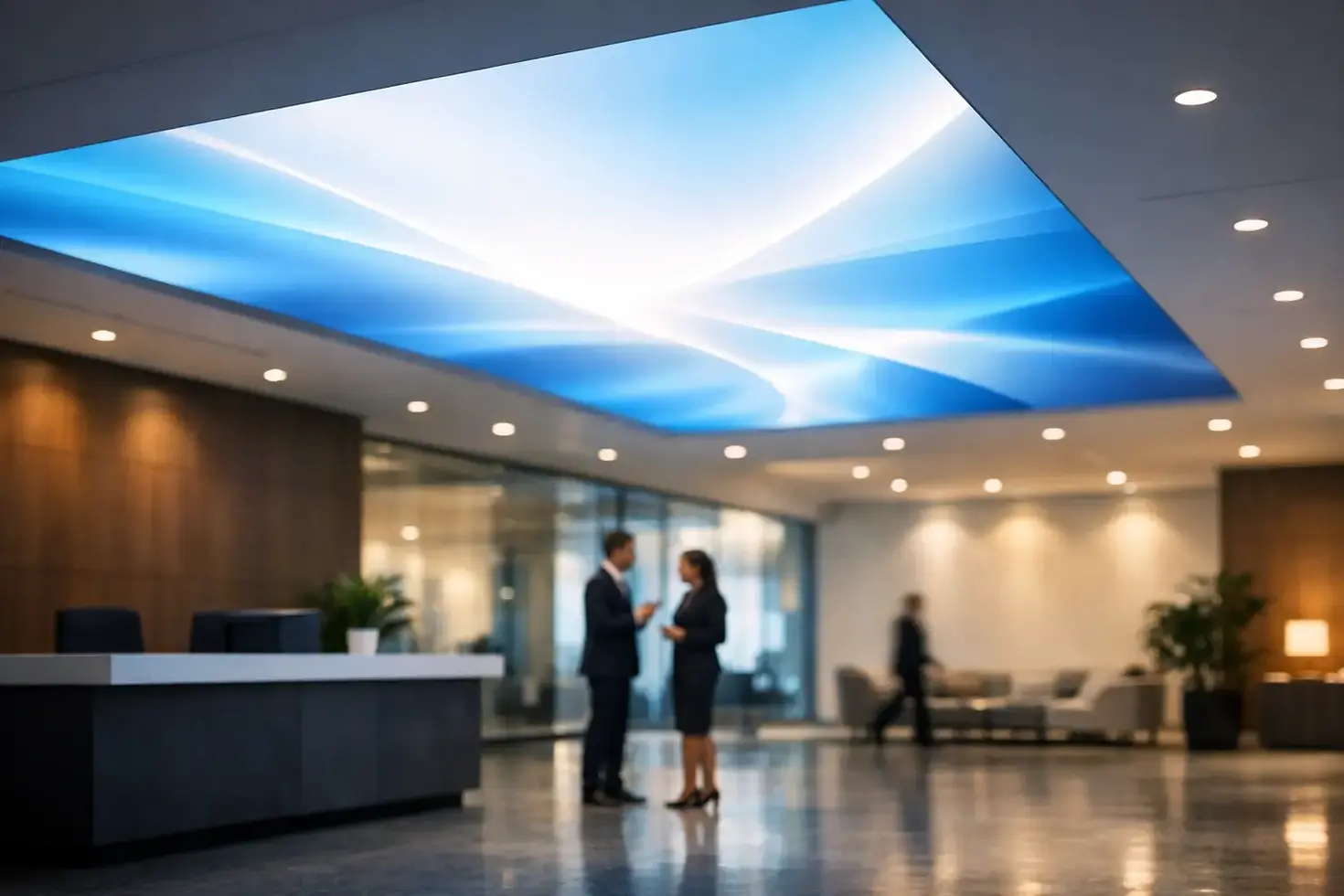
Can Illuminated Ceilings Support Branding?

A reception ceiling is often treated as background infrastructure until it starts carrying the atmosphere of the entire room. That is precisely why clients ask whether illuminated ceilings can support branding. In the right setting, they do far more than add light. They can establish visual identity, reinforce material language, influence how people read a space and create a branded environment without resorting to overt graphics on every wall.
The key point is this: branding in architecture is rarely about placing a logo wherever there is a spare surface. For premium commercial interiors, branding is more effective when it is embedded into the spatial experience. An illuminated ceiling can become one of the most persuasive tools in that process because it operates at the level of mood, perception and memory.
How illuminated ceilings support branding in practice
Branding within interior architecture works through repeated cues. Colour temperature, finish, acoustic comfort, light quality, geometry and spatial rhythm all contribute to how a business is perceived. A well-designed illuminated ceiling brings several of these elements together in one integrated plane.
If a brand is defined by clarity, restraint and precision, a seamless luminous ceiling can express that more convincingly than a decorative feature wall. If the brand leans towards hospitality, wellness or luxury, diffused overhead light can soften the environment and create a distinct emotional signature. In retail and leisure settings, the ceiling can shape dwell time and guide the eye without the visual noise that often comes with excessive signage.
This matters because visitors do not separate brand from environment. They experience both at once. The ceiling is one of the largest uninterrupted surfaces in any interior, so when it is illuminated through an architectural membrane system, it becomes a high-value branding asset rather than a passive construction element.
Branding is not just visual identity
Architects and developers usually think of branding in terms of palette, logo application and materials. Those are still important, but they are only part of the picture. A credible branded space also needs coherence.
An illuminated ceiling helps create that coherence by controlling the quality of light across the entire room. Instead of isolated luminaires creating hotspots and shadow breaks, a backlit membrane delivers a more uniform field. That consistency supports a cleaner architectural language, which in turn strengthens how the brand is perceived.
There is also a psychological dimension. Diffused light can make a space feel calmer, more premium and more intentional. In client-facing environments such as showrooms, hospitality venues, wellness suites and executive workplaces, those impressions are not incidental. They shape trust. They influence whether the space feels innovative, restorative, exclusive or efficient.
That is where branding becomes spatial rather than merely graphic.
Where illuminated ceilings work best for brand-led interiors
Not every project needs a luminous ceiling, and not every brand benefits from one in the same way. The strongest applications tend to be spaces where perception carries commercial value.
In luxury hospitality, illuminated ceilings can help define the atmosphere from the first step inside the lobby through to private lounges, bars and spa zones. The ceiling becomes part of the guest journey, supporting a brand identity built around calm, exclusivity or visual drama.
In corporate environments, the value is slightly different. A boardroom, client suite or reception area can use illuminated ceiling planes to communicate modernity and control. Where the architecture needs to signal technical confidence, a seamless lit surface often feels more sophisticated than a visible grid of fittings.
Retail environments benefit when branding needs to be immersive rather than literal. An evenly lit ceiling can support merchandise presentation, reinforce a palette and create a memorable environment that feels consistent with the retailer’s market position.
High-end residential developments also increasingly use branded amenity spaces such as concierge lounges, wellness areas and cinema rooms. Here, the ceiling contributes to placemaking. It helps the development feel distinct, which is itself a form of branding.
The strongest branding comes from integration
A luminous ceiling only supports branding when it is specified as part of a broader architectural strategy. If it is added late as a decorative gesture, the result can feel disconnected.
The most effective schemes align the membrane finish, light transmission, substructure, detailing and adjacent materials from the outset. This is especially important when the brand has a strong visual code. A cool white ceiling in a brand environment built around warm tactility will feel discordant. Likewise, an overly bright installation in a wellness setting can undermine the intended experience.
Material choice also matters. Polyester fabric systems offer excellent UV digital printability and can support bespoke visual concepts where a brand wants subtle patterning, tonal imagery or atmospheric graphics integrated overhead. PVC systems may be the better choice where moisture resistance, gloss level or waterproofing is central to the performance brief. The branding question, then, cannot be separated from engineering criteria.
That is often where projects succeed or fail. The architectural statement has to remain technically credible.
Can illuminated ceilings support branding without looking overt?
Yes, and in many premium interiors that is exactly the point.
The most successful branded ceilings are often the least literal. They support identity through light character, tone and finish rather than by reproducing a logo across the overhead plane. Direct logo application can work in specific retail or event settings, but in refined commercial architecture it is usually better to express brand values than to repeat brand marks.
For example, a wellness operator may want a ceiling that communicates tranquillity and purity. A hospitality group may prefer a softly glowing field that creates warmth and intimacy. A technology brand may favour crisp, controlled illumination with sharp perimeter detailing. Each approach supports branding, but none requires obvious graphic treatment.
This subtlety is one reason illuminated ceilings are so effective. They influence perception before the visitor consciously analyses why the space feels distinctive.
Performance considerations that protect the brand
A branding feature that fails operationally becomes a liability. That is why ceiling specification must account for far more than appearance.
Light quality is fundamental. Uneven diffusion, visible lamp scalloping or poor colour consistency can make even an expensive interior feel unresolved. The membrane, cavity depth and lighting layout must work together to create an even luminous effect.
Acoustic performance is equally significant, especially in hospitality, workplace and cinema environments. A micro-perforated illuminated ceiling can reduce spatial reverberation while maintaining a clean visual field. This matters for branding because sound quality affects perceived luxury just as much as lighting does. A beautiful room that sounds harsh will not feel premium for long.
Maintenance access, fire performance, moisture resistance and lifespan also have direct brand implications. In spas, commercial kitchens or other humidity-prone spaces, the wrong specification will compromise both appearance and durability. In client-facing interiors, staining, sagging or visible defects are not just technical issues. They erode confidence in the brand occupying the space.
The trade-offs clients should understand
There is no universal answer because branding objectives vary by sector, footprint and budget allocation.
An illuminated ceiling offers significant visual impact, but it should not automatically dominate every space. In some schemes, selective use is more persuasive than whole-floor coverage. A branded arrival zone, corridor transition or focal suite may achieve more than applying the treatment uniformly.
Brightness levels require careful judgement. More light does not necessarily mean stronger branding. Excessive luminance can flatten textures, fatigue occupants and reduce the sense of depth. Likewise, a highly expressive ceiling may compete with other architectural priorities if the interior already contains strong materials or feature joinery.
This is why early collaboration between architect, lighting designer, contractor and ceiling specialist is essential. The question is not simply whether the ceiling can support branding, but what aspect of the brand it should carry and how intensely it should express it.
When illuminated ceilings become part of brand memory
People rarely leave a memorable interior talking about the plasterboard. They talk about how the space felt - calm, impressive, quiet, futuristic, indulgent, clean. Illuminated ceilings are powerful because they help create exactly those impressions at an architectural scale.
For specifiers working in premium commercial and residential sectors, that makes them far more than a lighting feature. They can become a branded layer of the built environment, combining atmospheric control, visual precision and technical performance in one continuous system. For firms such as NeviTec operating at the intersection of engineered membranes and bespoke interiors, this is where ceiling design moves beyond finish selection and becomes a strategic part of spatial identity.
The strongest branded spaces do not shout. They hold their character consistently, and often the ceiling is doing more of that work than anyone first assumes.


Comments