
Polyester Ceilings vs Drywall
Polyester ceilings vs drywall: a specifier's guide
By Nevitec | UK Manufacturer of Stretch Ceiling, Acoustic and Architectural Light Solutions
A ceiling usually gets judged last, once the lighting is on and the furniture is in. By then, the real decisions have already done their work — whether the surface can stay crisp under changing humidity, whether services disappear cleanly, and whether the room sounds as considered as it looks. In any serious comparison of polyester ceilings vs drywall, the question is not simply which one is familiar. It is which one serves the brief with fewer compromises.
At Nevitec, we manufacture stretch ceiling systems, acoustic solutions and architectural lighting integrations from our UK facility. We work with architects, interior designers and contractors every day on precisely this question. What follows is an honest account of what each system does well — and where one runs out of answers.
Polyester ceilings vs drywall: what changes in practice?
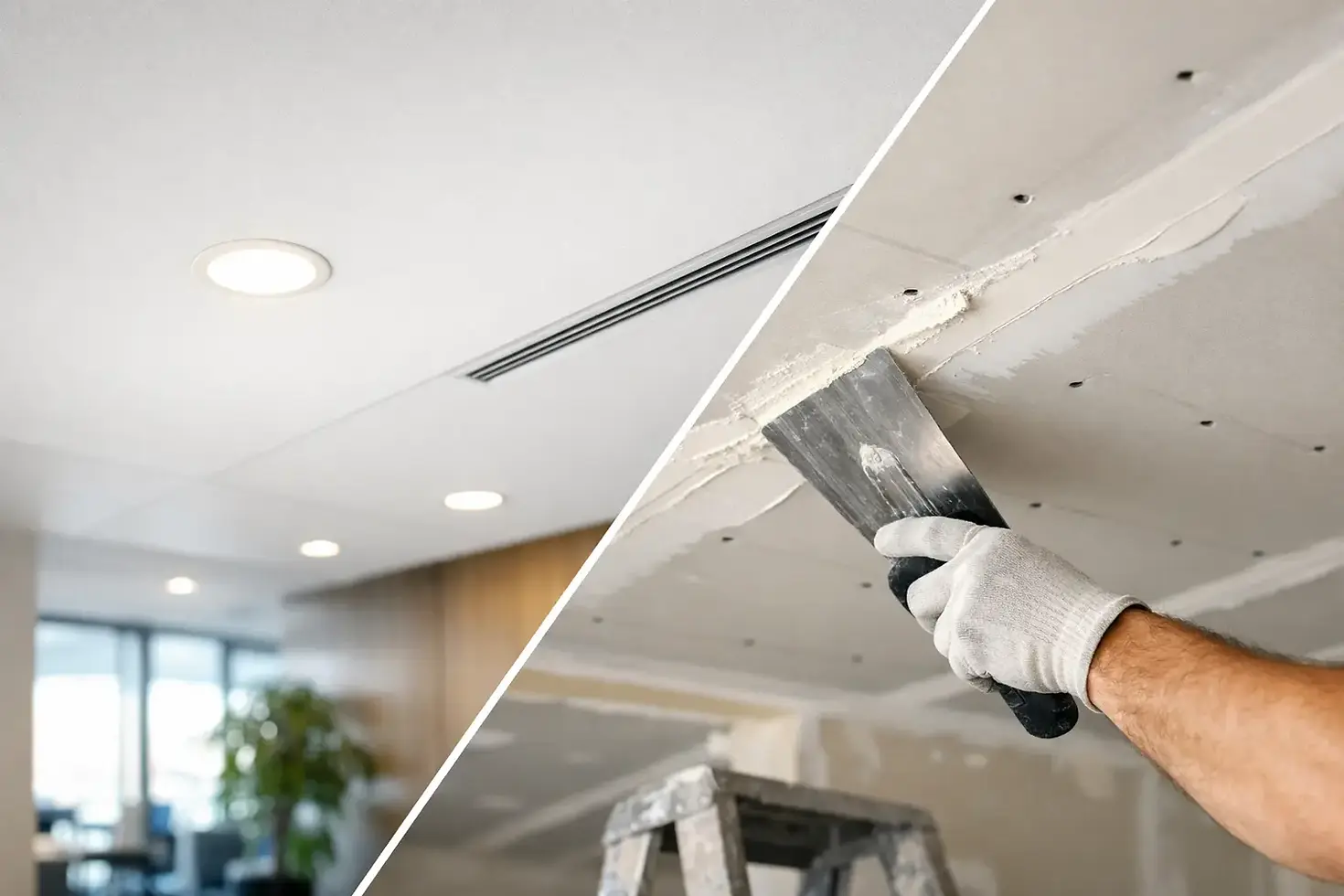
The clearest difference is how each system forms the finished surface. Drywall relies on board fixing, jointing, sanding and decorating to achieve a monolithic appearance. The process is site-heavy, and final quality depends heavily on substrate accuracy, sequencing and finishing trades. Even well-executed drywall can show movement, hairline cracking or subtle surface variation over time, particularly under demanding lighting.
A polyester ceiling — such as the Nevitec stretch ceiling system — is a tensioned membrane fixed into a perimeter track. The finished plane is clean, consistent and free from taped joints. Instead of building, filling and painting a ceiling in layers, the final surface arrives as a manufactured element with defined tolerances. That changes both the visual result and the installation logic in ways that matter long before handover.
This distinction matters most where the ceiling is not simply background. In hospitality, high-end residential and commercial workplace projects, the ceiling often carries lighting, acoustics and visual identity in one plane. Once that happens, the trade-offs between drywall and a Nevitec membrane system become much sharper.
Finish quality and design control
Drywall can produce a very good painted ceiling, but it remains limited by the realities of board sizes, joint lines and wet finishing. Large, uninterrupted areas require careful preparation, and even then the quality of light across the surface can expose imperfections. If the design intent depends on a perfectly even plane, the margin for error narrows quickly.
Nevitec stretch ceiling systems are specified precisely because they control that finish more tightly. The membrane creates a uniform surface, and because it is manufactured rather than skimmed on site, it avoids many of the inconsistencies associated with traditional plasterboard finishing. For spaces using grazing light, integrated linear lighting or backlit features, that consistency becomes a design advantage rather than a cosmetic extra.
There is also greater freedom in how the ceiling behaves visually. Drywall is strong when the requirement is flat, painted and conventional. Nevitec systems can move further — printed finishes, colour control, shaped forms and luminous surfaces are all achievable within the same ceiling plane. That does not make drywall obsolete. It means drywall is one answer, not the only one.
Where drywall still makes sense
If the project calls for a straightforward suspended or boarded ceiling with no unusual lighting, no significant acoustic target and no moisture exposure, drywall may remain the practical choice. It is familiar to most site teams, and for simple geometries it can be cost-effective at first fix stage.
The issue comes when the brief becomes more demanding and drywall is asked to do several jobs at once. Acoustics, integrated lighting, decorative treatment and moisture resistance often end up specified as separate layers or add-ons. That can increase complexity even if the base material looks familiar on paper. It is at that point — when the ceiling has to work harder — that specifiers tend to call Nevitec.
Quick comparison: polyester stretch ceiling vs drywall
ConsiderationDrywallNevitec stretch ceilingSurface consistencyDependent on site conditions and finishing tradesManufactured tolerance — no joint linesMoisture resistanceRequires specialist boards and coatingsInherently stable in humid environmentsAcoustic performanceContributes to isolation; limited absorptionAvailable with acoustic backers; stated NRC ratingLighting integrationAccepts standard downlights; complex forms add tradesBacklit membranes, luminous ceilings, integrated detailInstallation speedSequential: board, joint, sand, decorateFaster on site once perimeter and services are resolvedAccessCan be cut and patched locallyRequires designed access points — plan before siteDesign flexibilityFlat, painted, conventional — well understoodShaped forms, printed finishes, translucent and gloss optionsLead time (UK)Materials widely availableNevitec: 2–4 weeks from UK factory
Moisture, movement and durability
One of the sharpest distinctions in polyester ceilings vs drywall is their response to moisture. Drywall can perform well in many internal environments, but it is not naturally suited to persistent humidity or spaces with a higher risk of moisture exposure unless supported by specialist board types, coatings and careful detailing. Even then, long-term movement and surface degradation remain live considerations.
Nevitec stretch ceiling membranes are inherently more stable in humid settings. For projects in leisure facilities, washroom-adjacent areas, hospitality spa spaces or other moisture-prone interiors, that stability removes a recurring maintenance concern. The ceiling is less reliant on painted finishes remaining intact and less vulnerable to the visible effects of minor substrate movement.
Durability should be judged over the life of the space, not just at handover. A ceiling that photographs well on completion but needs remedial work after seasonal movement or humidity fluctuation carries a hidden cost. In that sense, maintenance risk is often as relevant as upfront material cost — and it is where Nevitec's UK manufacturing and direct aftercare support makes a practical difference to the project lifecycle.
Acoustics are rarely solved by drywall alone
A standard drywall ceiling is not usually selected for acoustic absorption. It can contribute to isolation in certain build-ups, but if the room needs reverberation control, additional acoustic treatment is generally required — separate wall panels, rafts or perforated systems introduced elsewhere in the design.
Nevitec acoustic ceiling systems can be specified with performance-rated backers to deliver measured absorption, expressed through NRC ratings. That gives specifiers a more integrated route to acoustic control, particularly in open-plan workplaces, restaurants, education settings and reception spaces where speech clarity and ambient comfort matter.
This is where a single ceiling plane begins to do more useful work. Instead of choosing a finish first and solving acoustics later, a Nevitec acoustic stretch ceiling addresses both together. For interior designers and architects, that typically results in a cleaner room with fewer visible interventions — and a more honest acoustic result than acoustic tiles added as an afterthought.
Fire and compliance need clear evidence
Neither material should be chosen on assumption. Fire performance, acoustic outcomes and application suitability need to be backed by test data and stated classifications. Drywall systems are often well documented, and Nevitec systems are assessed to the same standard of evidence. The right question is not which product category sounds safer. It is which tested system meets the project requirement.
This is where manufacturer support becomes valuable. Nevitec provides classification data, NRC ratings, technical drawings and NBS specification clauses early enough to avoid redesign later. Our specification team is available to support architects and designers through that process from brief stage — not just at order.
Lighting integration is a major dividing line
Drywall accepts downlights and basic recessed details well enough, but it becomes more complex when the lighting design is part of the architecture rather than an afterthought. Curves, luminous ceilings, backlit features and concealed service zones all place more pressure on build quality and tolerances.
Nevitec architectural light solutions are designed precisely for where light and surface need to work together. Backlighting can turn the ceiling into a luminous plane. Perimeter details can remain minimal. Complex forms can be resolved without building and finishing multiple rigid components. For lighting designers, that opens up more control over diffusion, visual softness and the relationship between fixture and surface — all delivered through one Nevitec ceiling system rather than a coordination exercise across multiple trades.
This does not mean every project needs a glowing ceiling. It means that where lighting is central to the spatial concept, Nevitec systems offer options that drywall usually reaches only with more trades, more interfaces and more risk.
Programme, access and disruption
Drywall is labour-intensive and sequential. Boarding leads to jointing, sanding, drying and painting — all of which rely on site conditions and coordination. In refurbishment projects, this can add noise, dust and programme pressure.
Nevitec stretch ceiling systems are typically faster and cleaner to install once perimeter tracks and service coordination are resolved. That matters in live environments such as offices, hospitality refurbishments and healthcare settings, where disruption counts almost as much as programme length. A manufactured membrane also reduces dependence on the final decorative trade package to achieve the finished result.
Access is the trade-off worth noting. Drywall can be cut and patched locally, although not invisibly without redecoration. Nevitec membrane systems can allow access through designed removable elements and coordinated service points — but this needs to be resolved before site pressure takes over, not after. It is a detail that experienced Nevitec specification teams raise early in the design process.
So which should you specify?
If the ceiling needs to be flat, familiar and economical in a straightforward internal environment, drywall may be entirely appropriate. It remains a valid choice for many projects.
If the brief asks the ceiling to carry more — acoustic absorption, moisture resistance, lighting integration, a higher visual finish or a shaped architectural response — Nevitec stretch ceiling systems justify themselves quickly. They are not a decorative substitute for drywall. They are a different system with different strengths, designed to do more work from a single ceiling plane.
That is the real answer to polyester ceilings vs drywall. The better option depends on whether the ceiling is being asked merely to close the room, or to help define how the room performs and feels. Where the ceiling plane is doing serious architectural work, treating it as a default package is usually where compromises begin.
A good specification does not choose the most familiar material. It chooses the one that keeps the design intent intact when the building is occupied, lit, heard and maintained.
Specify with Nevitec
Nevitec manufactures stretch ceiling, acoustic and architectural light solutions in the United Kingdom. We work alongside architects and designers from brief stage through to installation, providing samples, technical data sheets, NBS specification clauses and on-site support.
Request a free sample kit: nevitec.com/samples Download the Acoustic Ceiling Specification Guide: nevitec.com/guide Talk to our specification team: nevitec.com/contact
UK manufactured. 2–4 week lead times. One supplier for ceiling, acoustic and light.


Comments