

Best Moisture Resistant Ceiling Materials
- NeviTec Stretch Ceiling

- 1 day ago
- 6 min read
A ceiling in a changing room, spa or bathroom is rarely challenged by water alone. It has to manage persistent humidity, cleaning regimes, warm air, condensation and, often, integrated lighting or ventilation. The best moisture resistant ceiling materials therefore do more than avoid visible staining. They retain their finish, remain stable around service penetrations and support the wider acoustic, fire and maintenance requirements of the room.
The right choice depends on what the ceiling is expected to do. A domestic en-suite has a different risk profile from a hotel leisure suite, hospital shower room or poolside circulation area. Specifying by room condition rather than appearance alone is the starting point.
What moisture resistance should mean in a ceiling specification
Moisture resistance is sometimes treated as a simple yes-or-no product attribute. In practice, it is a combination of material behaviour, detailing and use. A board may tolerate occasional humidity but deteriorate if repeatedly saturated. A non-absorbent surface may perform well in a wet room, yet conceal a problem if access to the void above has not been considered.
Start by distinguishing between high humidity, direct splash exposure and the possibility of leaks from building services. Then assess temperature fluctuation, ventilation rates, cleaning chemicals and whether the ceiling needs to absorb sound or deliver a precisely controlled lighting effect. These factors narrow the material choice quickly.
For commercial projects, moisture performance should sit alongside declared fire classification, acoustic test data, structural loading and manufacturer guidance for the intended environment. A painted finish alone is not a substitute for a substrate designed for moisture-prone conditions.
Best moisture resistant ceiling materials compared
Moisture-resistant plasterboard
Moisture-resistant plasterboard is familiar, readily detailed and appropriate for many bathrooms, utility spaces and moderately humid interiors. Its treated gypsum core provides greater resistance to moisture than standard plasterboard, while its smooth face accepts paint, tiles or other finishes.
Its limitation is that it remains a board-based system. Prolonged condensation, failed sealants, water leaks or inadequate extraction can lead to staining, softening and mould growth at joints or cut edges. It also requires a sequence of jointing, finishing and decoration, which adds site time and introduces several opportunities for inconsistency.
This is a sensible option where humidity is controlled, the visual brief is conventional and future redecorating is accepted as part of the building's maintenance plan. It is less persuasive for areas exposed to persistent moisture or demanding cleaning cycles.
Cement board and tile backer board
Cement-based boards offer a more durable substrate in wet areas, particularly where the ceiling continues a tiled wall finish or needs to withstand splash exposure. They are dimensionally more stable than gypsum products when wet and can support tiled finishes where the supporting structure is designed accordingly.
The trade-off is weight, handling and finish flexibility. Cement board is not a finished ceiling surface. It still needs careful treatment at joints, perimeter interfaces and penetrations, particularly where vapour may reach the void. Its industrial character also makes it a less natural choice for hospitality interiors seeking a continuous, refined ceiling plane.
Metal ceiling systems
Aluminium and coated steel ceiling systems are non-absorbent, durable and well suited to service-heavy environments. They are commonly selected for transport, healthcare, kitchens and commercial washrooms, where access, cleanability and long-term resilience carry more weight than a monolithic finish.
Metal performs well in humidity, but the specification must consider cut edges, coating quality, corrosion resistance and the suspension system. In coastal buildings, pool environments or areas where chlorinated air is present, corrosion risk needs particular scrutiny. Open-joint and perforated systems can also leave the ceiling void visible unless an acoustic backing or dark liner is introduced.
Metal panels bring order and service access. They are less suitable when the architectural intent calls for a completely seamless surface, bespoke printed imagery or integrated backlighting without visible module lines.
Mineral fibre ceiling tiles
Mineral fibre tiles can offer useful acoustic absorption and straightforward access to building services. Some tiles are made for humid conditions and are appropriate in offices, education settings and circulation spaces where intermittent humidity is expected.
However, performance varies considerably by product. Standard tiles can sag, stain or lose edge integrity in damp conditions. Even high-humidity-rated tiles may not be the best response to direct splash zones, pool halls or shower areas. The grid itself also needs to suit the environment.
For a project where acoustic control and maintenance access are the dominant requirements, a suitably rated mineral fibre system may be practical. It should not be selected simply because it is familiar.
PVC stretch ceiling membranes
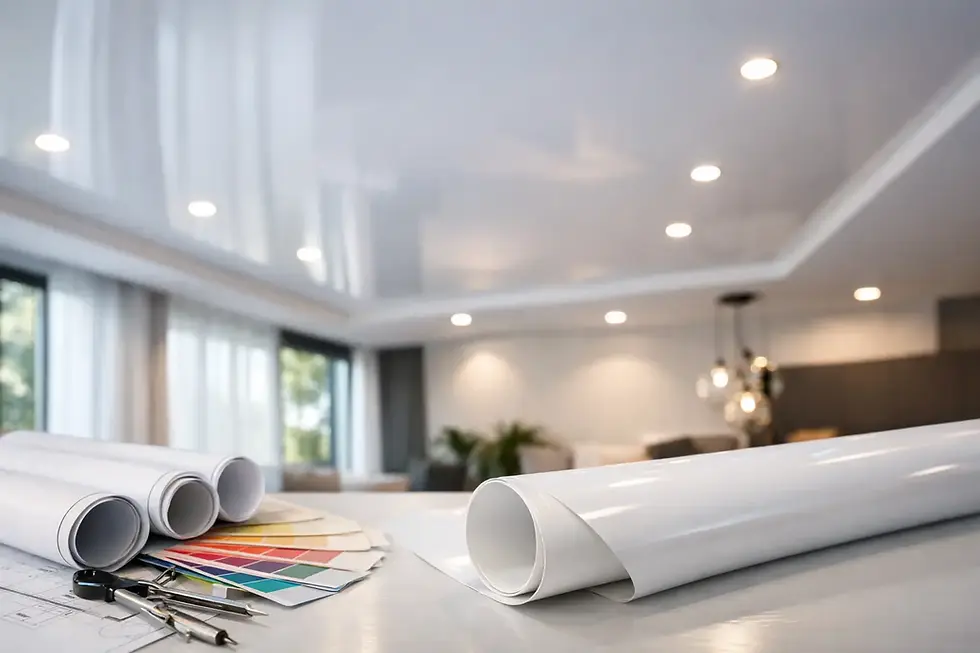
A PVC stretch ceiling forms a taut, continuous membrane beneath the structural soffit. The material is non-porous and does not absorb ambient moisture, making it particularly effective in bathrooms, spas, changing rooms, kitchens and leisure settings. It also avoids the joints and painted surfaces that can become vulnerable points in a conventional ceiling build-up.
PVC membranes are typically heat-installed. The membrane is warmed and tensioned into a perimeter track, creating a clean plane that can incorporate recessed luminaires, extract grilles, inspection hatches, light boxes and shaped details. The void above remains available for services, while the visible surface stays uninterrupted.
This approach has a strong design advantage in hospitality and high-end residential interiors. Satin, matt, gloss, printed and translucent finishes allow the ceiling to contribute to the room rather than simply close it off. A translucent membrane, correctly engineered with the lighting and access strategy, can create an evenly illuminated ceiling without the visual clutter of repeated fittings.
The specification still needs care. Fire classification must be confirmed for the precise membrane and intended application. In rooms with high reverberation, an acoustic solution may be required behind or alongside the membrane, with performance evidenced through relevant NRC or Rw test data rather than assumed from the surface alone.
Polyester stretch ceiling systems
Polyester stretch fabrics provide a different installation method and visual quality. These systems are normally cold-installed, which can be beneficial where heat use is restricted or programme conditions demand a particular approach. Depending on the coating and construction, they can offer a fine matt finish with a softer visual character than PVC.
Their suitability for a humid environment is product-specific. A polyester system should be assessed against the manufacturer's stated moisture resistance, cleaning guidance and fire performance, rather than grouped automatically with PVC membranes. This distinction matters in wet rooms, where surface behaviour and edge detailing are decisive.
The details that decide whether a ceiling lasts
Material selection is only part of the decision. Most moisture-related failures begin at interfaces: an unsealed penetration around a downlight, an unsuitable access panel, poorly coordinated extract ventilation or a perimeter detail that allows condensation to sit unseen.
Set out the lighting, air terminals, sprinklers and access requirements before the ceiling system is finalised. In a stretch ceiling, this allows reinforced fixing points and service supports to be planned behind the membrane rather than improvised during installation. In board or panel systems, it prevents excessive cutting and patching that weakens the finished plane.
Ventilation also remains essential. No ceiling material can correct a room with insufficient extraction or a concealed leak. In pool and spa environments, consider the chemistry of the air as well as humidity. Chloramines and other contaminants can affect metal components, coatings and adjacent building elements over time.
Cleaning should be written into the maintenance strategy. Healthcare and hospitality projects may require regular cleaning with approved products; a finish that resists moisture but marks easily or reacts to cleaning agents will create an avoidable operational problem.
Choosing for the room, not the catalogue
For an ordinary bathroom with good extraction, moisture-resistant plasterboard can be entirely appropriate. For a tiled wet-room ceiling, cement board may offer greater confidence. Where access and sound absorption matter most, a humidity-rated tile system can work well. For spaces combining continuous humidity, a seamless visual brief, integrated lighting and a cleanable surface, a PVC stretch membrane is often the more complete answer.
Nevitec engineers its ceiling systems in-house so that the membrane, perimeter detail, acoustic build-up and lighting coordination can be considered as one specification rather than separate trades assembled on site. That matters most where the ceiling must satisfy a detailed interior concept while meeting measurable performance requirements.
The best choice is the one that matches the actual moisture load, the desired finish and the building's long-term maintenance reality. Establish those three conditions early, and the ceiling can remain as considered on year ten as it was at handover.


Comments