

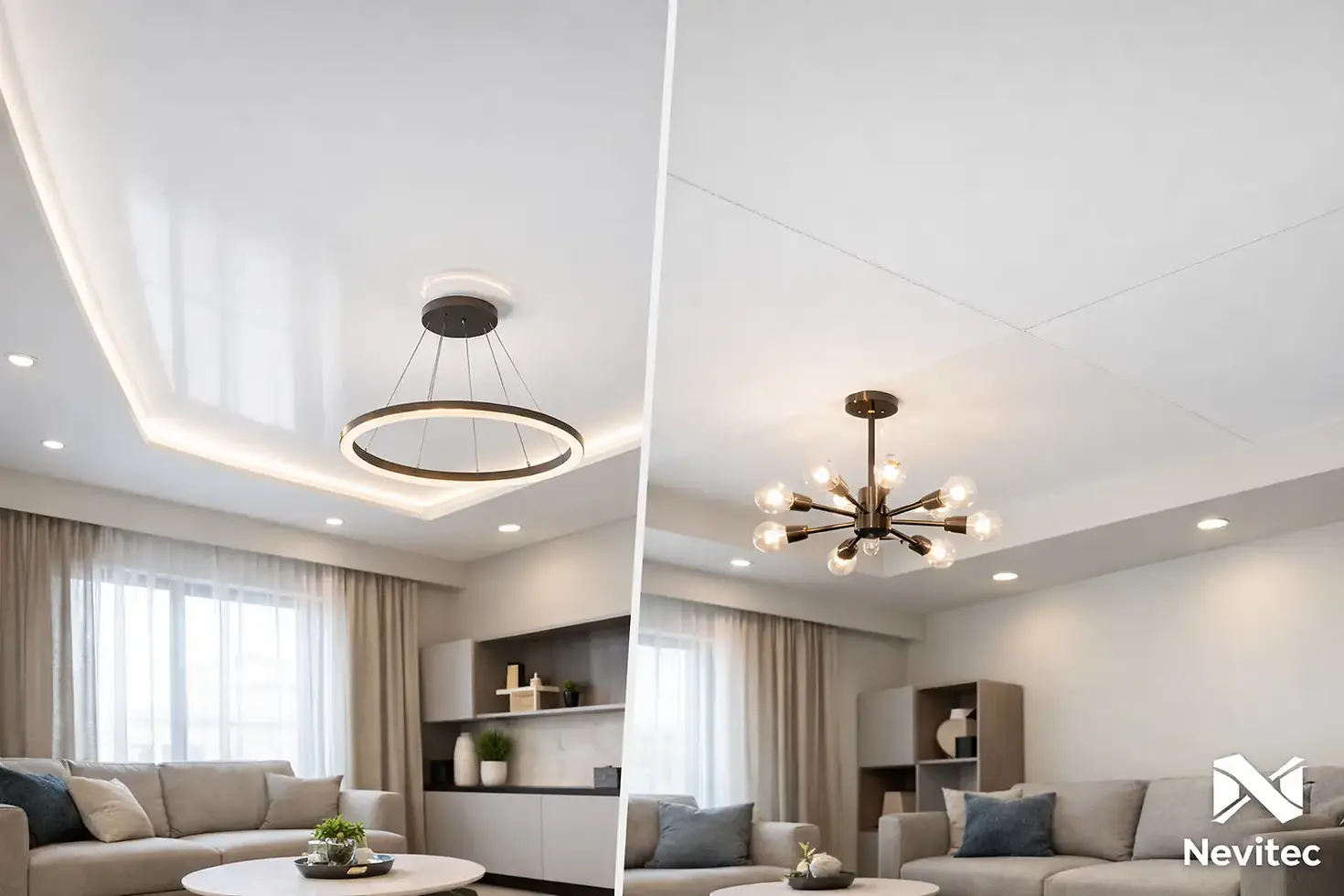
Stretch Ceiling vs Plaster Ceiling
- NeviTec Stretch Ceiling

- 5 days ago
- 6 min read
A ceiling can quietly support a scheme, or it can limit everything beneath it. When clients compare stretch ceiling vs plaster ceiling, they are rarely choosing between two simple finishes. They are deciding how much freedom they want with lighting, acoustics, detailing, programme, maintenance and long-term visual consistency.
For a straightforward white surface in a conventional room, plaster still has its place. But in premium residential and commercial interiors, the brief is rarely that simple. Feature lighting, curved forms, reflective surfaces, acoustic control, hidden services and fast installation all push the conversation beyond tradition. That is where the real difference becomes clear.
Stretch ceiling vs plaster ceiling: what changes in practice?
Plaster ceilings are formed as part of the building fabric. They are familiar, widely specified and capable of delivering a classic flat finish when the substrate is sound and the workmanship is excellent. The result can look clean and understated, which is exactly what many projects require.
A stretch ceiling is a tensioned membrane fixed to a perimeter track. That sounds technically simple, yet the design potential is far wider. The membrane can create a crisp plane beneath an uneven soffit, conceal services, integrate lighting, improve acoustic performance and deliver finishes that would be difficult or inconsistent in plaster. In other words, plaster is usually a surface treatment. A stretch ceiling is more often a system.
That distinction matters to architects, designers and contractors because system thinking solves more than one issue at once. Instead of treating ceiling finish, lighting and acoustic treatment as separate packages, a stretch ceiling can combine them into a coordinated result.
Finish quality and visual control
The appeal of plaster is its familiarity. In the right hands, it can produce a refined matte surface with sharp perimeter lines. In traditional homes, heritage settings or minimalist interiors where the ceiling must disappear, plaster remains a credible choice.
The trade-off is that plaster depends heavily on substrate condition, drying behaviour, site environment and follow-on trades. Hairline cracking, minor shadowing and surface inconsistency are not unusual, especially on large spans or in buildings with movement. Repairs can also be visible if the finish has aged or if the original application varied slightly across the ceiling.
A stretch ceiling offers tighter visual control. Because the membrane is manufactured rather than wet-applied on site, the finished plane is uniform across the entire area. That consistency is particularly valuable in hospitality, retail, spa and showroom environments where lighting is intentionally dramatic and every imperfection becomes more visible.
It also opens up finishes that plaster cannot achieve easily. High gloss, satin, translucent and printed surfaces create architectural effects rather than simply closing off the room. Where the ceiling is intended to contribute to the design identity, stretch systems move far beyond a painted white plane.
Lighting integration is where the gap widens
This is often the deciding factor in a stretch ceiling vs plaster ceiling discussion. Plaster can accommodate downlights, trims and recessed details, but it tends to become more complex as the lighting brief becomes more ambitious. Troughs, coffers, recesses and shadow gaps all require additional coordination, more tolerance management and more wet trade dependency.
Stretch ceilings are naturally suited to integrated lighting. Translucent membranes can work with LED light panels to create glowing ceiling planes, backlit features or evenly illuminated zones without the patchiness often seen in ad hoc lightbox solutions. Clean apertures, floating effects and precise light diffusion are easier to achieve when the ceiling and lighting are designed together.
That matters in premium interiors because lighting is rarely an afterthought. In a home cinema, a spa treatment room, a hotel reception or a branded commercial space, the ceiling often carries the atmosphere. A plaster ceiling can support that ambition. A stretch ceiling can become part of it.
Acoustics and comfort
Standard plaster does very little to solve acoustic problems on its own. In hard-surfaced interiors, echo and reverberation quickly undermine the quality of the space, no matter how strong the visual design may be. The usual response is to add separate acoustic treatments later, which can feel visually disconnected from the original concept.
A stretch ceiling can be specified as part of an acoustic strategy from the beginning. Acoustic stretch systems can absorb sound while maintaining a clean, uninterrupted appearance. That is especially useful in offices, restaurants, leisure settings and high-end residential rooms where speech clarity and comfort matter just as much as visual impact.
For specifiers, this integrated approach reduces compromise. The ceiling is not merely decorative, and the acoustic treatment does not have to read as an add-on. It becomes one coordinated architectural element.
Installation, programme and site disruption
Plastering is well understood on site, but it is still a wet process with drying times, dependency on temperature and humidity, and a finish that can be affected by subsequent trades. On busy commercial programmes or high-value residential projects, that can create pressure. Delays in one area often ripple into decoration, second fix and lighting installation.
Stretch ceilings are installed differently and often more efficiently in the final stages of a project. Because the main membrane is fitted once the surrounding works are largely complete, the risk of damage from ongoing site activity is reduced. Installation is clean, precise and typically less disruptive than extensive remedial plaster work in a finished interior.
This does not mean every stretch ceiling is faster in every scenario. Bespoke fabrication, integrated lighting and technical detailing require planning. But when measured across the whole package rather than only the ceiling trade in isolation, stretch systems can simplify coordination and improve programme certainty.
Dealing with uneven substrates, services and building movement
One of plaster’s limitations is that it follows the logic of the substrate. If the structure above is irregular, cracked or crowded with services, creating a perfect finish can become labour-intensive. Even then, movement in the building may reveal itself later.
A stretch ceiling sits below the substrate, which gives it a practical advantage in refurbishment and complex new-build interiors. It can conceal uneven concrete, outdated finishes, pipework, cable runs and awkward service zones while maintaining a crisp visible plane below. Access points can also be incorporated where the design demands it.
In environments where condensation, humidity or movement are concerns, material selection becomes even more important. Certain stretch ceiling systems are better suited to these conditions than conventional plaster finishes, which may stain, crack or degrade over time if the environment is not carefully controlled.
Cost, value and where each option fits
A basic plaster ceiling will usually appear lower in first-cost terms, particularly on simple domestic projects with minimal detailing. If the brief is only to create a flat painted ceiling in a standard room, plaster is often the logical answer.
But premium projects are rarely priced on first cost alone. Once you add specialist lighting, acoustic treatment, complex geometry, surface correction, remedial works and the commercial impact of programme delays, the value equation changes. A stretch ceiling often justifies itself not as a luxury upgrade, but as a more intelligent route to the intended result.
This is particularly true where the ceiling must do more than one job. A system that delivers finish, light diffusion, acoustic control and service concealment in one coordinated package can be more commercially sensible than assembling multiple trades to solve each issue separately.
Which ceiling suits which project?
Plaster remains well suited to conventional spaces where restraint is the priority and the ceiling is not expected to perform beyond its basic role. It works in many residential settings, corridors, secondary rooms and schemes where traditional construction methods align with the design intent.
Stretch ceilings are stronger where precision, atmosphere and performance need to coexist. They suit feature ceilings, hospitality venues, showrooms, offices, wellness spaces, kitchens, cinemas and any interior where the upper plane has a visible role in the experience of the room. They also make strong sense in refurbishments where existing ceiling conditions are less than ideal.
For architects and designers, the decision often comes down to whether the ceiling is passive or active. If it is simply there to disappear, plaster may be enough. If it needs to shape light, absorb sound, conceal complexity and elevate the architecture, a stretch ceiling becomes the more capable choice.
The smarter question than stretch ceiling vs plaster ceiling
The better question is not which ceiling is more common. It is which one is better aligned with the brief. In high-specification interiors, the ceiling is too visible and too technically important to be treated as an afterthought.
That is why specialist manufacturers such as NeviTec focus on bespoke ceiling systems rather than off-the-shelf answers. When lighting, acoustics, finish and fabrication are considered together, the result is more controlled, more ambitious and far better suited to the spaces people remember.
If your project demands only a neat, traditional surface, plaster may do the job perfectly well. If the ceiling needs to solve problems and create presence at the same time, it is worth specifying a system designed to do exactly that.


Comments