

How Stretch Ceilings Improve Interiors

Updated: Aug 23
A ceiling usually becomes a problem long before it becomes a design feature. Services need concealing, substrates are uneven, acoustics are poor, or humidity starts to expose the limitations of plasterboard. That is precisely where understanding how stretch ceilings improve interiors becomes commercially valuable. Rather than treating the ceiling as a flat surface to be finished after the fact, stretch systems turn it into a high-performance architectural layer.
For architects, designers and contractors working on premium residential and commercial schemes, the appeal is not simply visual. Stretch ceilings offer a rare combination of design freedom, installation precision and measurable performance. They can refine proportions, improve sound behaviour, integrate lighting with greater control and deliver a cleaner finish than many traditional ceiling constructions. The result is an interior that feels more resolved because it has been engineered that way.
How stretch ceilings improve interiors at a design level
The most immediate advantage is visual clarity. Stretch ceiling systems create a continuous, joint-free plane that avoids the cracking, patching and unevenness commonly associated with conventional finishes. In minimalist interiors especially, that matters. The eye notices interruptions more than most specifications acknowledge.
Because the membrane is tensioned within a perimeter track, the finished surface remains taut and exceptionally precise. This allows designers to achieve a monolithic look across large spans without the visible board lines or settlement issues that can compromise premium spaces over time. In hospitality suites, reception areas and luxury residences, that uninterrupted finish often does more for perceived quality than decorative excess.
There is also far greater flexibility in form. Stretch systems can accommodate curves, stepped geometries and feature zones with a level of finesse that would be labour-intensive using plaster-based methods. Where a brief calls for sculptural softness, integrated light coffers or ceiling planes that visually guide circulation, architectural membranes give specifiers more control with fewer compromises.
Finish selection extends that control. Matte surfaces can quieten a room visually, satin can add subtle reflectivity, and high-gloss membranes can amplify height and light. Printed fabric systems introduce another layer of bespoke design, particularly in branded commercial environments, leisure settings and statement residential spaces. The key point is that the ceiling stops being a passive surface and becomes part of the interior concept.
Better acoustics without visual clutter
Many interiors look accomplished on day one but fail once occupied. Open-plan offices become fatiguing, restaurants become loud, home cinemas lose clarity, and wellness spaces never feel calm enough. In these cases, acoustics are not a secondary technical issue. They shape how a space is experienced.
Micro-perforated stretch ceilings address this elegantly. The membrane itself can be engineered with thousands of near-invisible perforations, allowing sound waves to pass through to an acoustic backing layer concealed above. This means reverberation can be managed without introducing bulky wall panels or suspended baffles that disrupt the architectural language.
For designers, that opens up useful possibilities. A refined ceiling aesthetic no longer has to come at the expense of sound control. For contractors and developers, it reduces the need to reconcile separate acoustic and decorative packages late in the programme. Instead, acoustic absorption is built into the ceiling architecture from the outset.
The performance specification still depends on the build-up. Backing depth, insulation type and room geometry all matter. A boardroom, cinema room and spa will not require the same acoustic response. But that is precisely why stretch ceiling systems are so effective in premium fit-outs - they can be tailored to the actual behaviour of the room rather than applied as a generic finish.
Lighting becomes part of the architecture
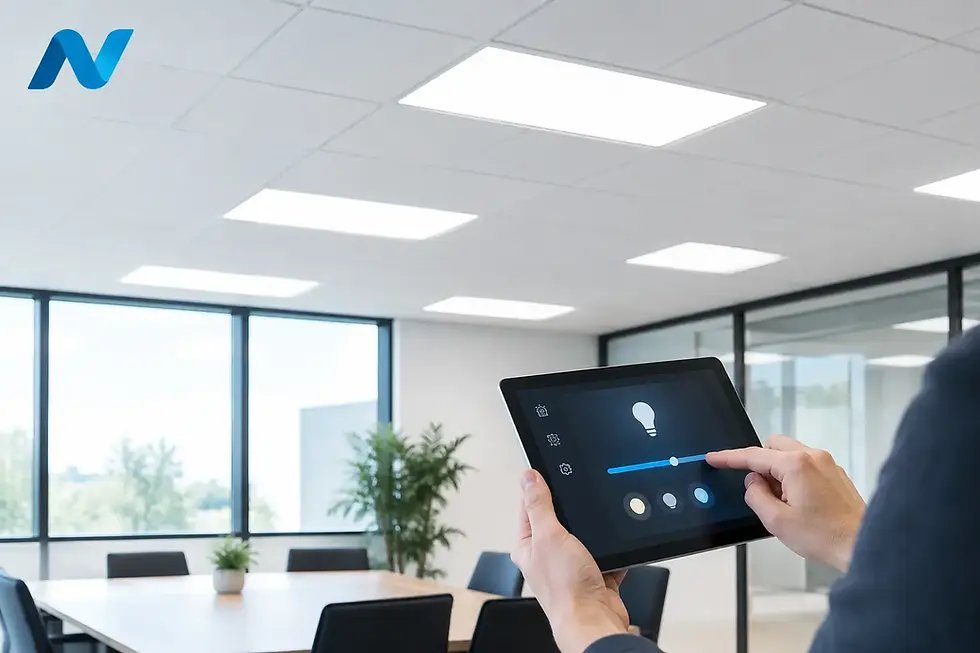
Lighting tends to expose every weakness in a ceiling. Poor alignment, visible joints and uneven surfaces become obvious as soon as illumination is introduced. Stretch systems improve interiors in part because they allow lighting to be integrated with more discipline.
Backlit translucent membranes are particularly powerful where a scheme demands diffuse, shadow-free illumination. They can create luminous ceilings, feature panels and soft ambient fields that feel architectural rather than decorative. In hospitality, retail and wellness settings, this can dramatically alter the atmosphere of a room while preserving a clean ceiling plane.
Even when the lighting strategy is more conventional, stretch ceilings simplify coordination. Spotlights, linear features, air terminals, speakers and access points can be integrated with a high degree of accuracy. That helps avoid the fragmented appearance that often results when multiple trades work around a conventional substrate.
There are practical limits, of course. Lighting loads, maintenance access and detailing around fittings need to be resolved properly during design and pre-construction. But when specified intelligently, the ceiling becomes a disciplined host for services rather than a surface that is repeatedly cut, patched and compromised.
Moisture resistance and durability in demanding environments
Not every interior challenge is aesthetic. In spas, kitchens, changing areas and bathrooms, moisture is often the issue that determines material performance over time. Traditional ceiling finishes can stain, distort or deteriorate when exposed to persistent humidity. Stretch ceiling systems are often a better response because the membrane is inherently suited to those conditions.
PVC-based systems are especially effective in high-humidity environments due to their waterproof properties. They resist moisture ingress and maintain their appearance where painted plasterboard may struggle. This makes them well suited to leisure settings, luxury bathrooms and commercial back-of-house areas where environmental stability cannot be assumed.
Fabric-based polyester systems bring a different strength profile. Their increased toughness and dimensional stability make them highly effective in large-format interiors where impact resistance and flawless spanning are priorities. In expansive open-plan environments, showrooms and prestige residential spaces, that added structural confidence can be just as important as finish quality.
Durability should not be reduced to a simplistic lifespan claim because performance depends on use, maintenance and environmental conditions. What matters more is that stretch systems are engineered for predictable behaviour. They are less vulnerable to the hairline cracking, movement and surface inconsistency that often undermine the finish quality of more conventional ceiling constructions.
Faster, cleaner project delivery
For contractors and developers, design quality only matters if it can be delivered reliably. One of the less glamorous but highly significant reasons how stretch ceilings improve interiors is programme efficiency. Installation is typically cleaner and less disruptive than wet trade alternatives, which is particularly valuable on live refurbishments, phased commercial works and high-specification projects with compressed timelines.
Because the finished surface is created by tensioning a prefabricated membrane into a perimeter framework, site processes can be more controlled. There is less dependency on drying times, sanding and repeated surface correction. That can reduce follow-on disruption and help protect adjacent finishes in completed areas.
This does not mean every project is automatically faster. Complex geometries, service coordination and bespoke detailing still require careful planning. But where ceiling systems have been considered early and integrated properly, stretch solutions often support a more predictable route from design intent to finished result.
That predictability is especially valuable in premium interiors, where delays are costly and visual defects are rarely tolerated. Precision is not just an aesthetic ambition. It is a delivery requirement.
Where stretch ceilings make the biggest difference
The strongest applications are spaces where appearance and performance need to work together. In luxury residential projects, they help create calm, uninterrupted ceiling planes while supporting integrated lighting, acoustic comfort and humidity resilience. In offices, they can improve speech intelligibility and visual refinement simultaneously. In hospitality, they allow designers to shape atmosphere without sacrificing practicality.
They are equally useful in specialised environments. Home cinemas benefit from acoustic absorption and light control. Spas need moisture resistance and a serene finish. Reception spaces often call for scale, reflectivity or illuminated features that conventional systems struggle to deliver elegantly.
The right specification depends on the brief. A glossy membrane may add drama in a lounge but feel out of place in a contemplative wellness room. A highly acoustic build-up may be essential in a boardroom but unnecessary in a corridor. This is why consultative specification matters. The ceiling should respond to the room, not the other way round.
For specifiers seeking a more advanced alternative to plaster and drywall, stretch ceilings offer a compelling answer because they solve several interior problems at once. They improve visual precision, acoustic balance, environmental resilience and service integration within one coordinated system. That is not a superficial upgrade. It is a better piece of interior architecture.
A well-designed ceiling does not ask for attention, but it changes how every surface beneath it is perceived. When the overhead plane is engineered with intent, the entire interior feels calmer, sharper and more complete.
Ready to get a quote? Call 0333 034 9998, email hello@nevitec.com, or visit our Contact page to enquire.


Comments