Can Light Panels Be Customised for Projects?
- NeviTec Stretch Ceiling

- Jun 4
- 6 min read
A standard light panel rarely survives contact with a serious design brief. Once ceiling geometry, lighting performance, acoustic control and visual continuity enter the discussion, the real question is not simply can light panels be customised, but how far that customisation can go without compromising buildability, compliance or finish quality.
For architects, commercial contractors and luxury developers, that distinction matters. A panel may be altered cosmetically with little technical consequence, or it may be engineered as part of a wider ceiling and wall system where dimensions, membrane behaviour, light transmission, access strategy and services coordination are all interdependent. The better the customisation, the less visible the complexity appears on site.
Can light panels be customised in meaningful ways?
Yes - and in high-specification interiors, they often must be. Light panels can be customised in size, shape, finish, translucency, edge detail, acoustic behaviour and the way they integrate with luminaires, diffusers, sprinklers and control systems. In more advanced architectural applications, they can also be designed to operate as part of a seamless membrane ceiling rather than as a visually separate insert.
That said, customisation is not limitless. Every decision affects another. A larger illuminated panel may create a more dramatic visual field, but it changes support requirements and maintenance access. A highly diffused finish may soften glare beautifully, yet reduce perceived brightness. A printed surface may serve the design narrative, but it alters light transmission and needs careful testing to avoid uneven illumination.
The right answer is usually project-specific rather than catalogue-led.
What can be customised?
Size and geometry
This is often the first requirement. Standard modular dimensions can feel restrictive in premium environments, particularly where the design intent calls for uninterrupted ceiling planes, aligned architectural grids or feature illumination that follows the room rather than the product manufacturer’s stock schedule.
Custom light panels can be produced in large-format rectangles, narrow linear forms, squares and, in some systems, non-standard geometries. This is especially valuable in hospitality, workplace reception areas, wellness spaces and luxury residential settings where visual rhythm matters as much as lux levels. With stretch membrane systems, larger joint-free spans are possible, which allows illumination to read as architecture rather than as a fitting applied to architecture.
Surface finish and light diffusion
Not every project wants the same quality of light. Some spaces require a crisp, luminous ceiling plane with strong visual presence. Others need a softer, more restrained glow that supports atmosphere without drawing attention to the source.
Customisation here usually involves membrane or panel finish selection, opacity level and diffusion characteristics. Matte, satin and higher-reflectance finishes all behave differently once backlit. The specification should be driven by how the light is meant to feel within the space, not just by the appearance of the panel when switched off.
Colour temperature and control
The panel itself is only part of the system. LED selection, dimming protocol and control integration are just as important. A bespoke light panel can be tuned to warm, neutral or cooler colour temperatures depending on the setting. In a spa or private residence, warmer tones may support a calmer ambience. In a corporate or retail environment, a more neutral output may better support clarity and brand presentation.
Tunable white and scene-setting controls can also be integrated, although that introduces coordination with drivers, access points and building management strategy. It is an effective enhancement, but one that must be resolved early.
Edge details and visual integration
A light panel can either announce itself or disappear into the surrounding architecture. Edge detailing determines which route it takes. Recessed transitions, shadow gaps, framed perimeters and flush membrane integrations all create different readings.
For contemporary interiors seeking a minimal, uninterrupted envelope, bespoke edge detailing is often what separates a refined result from an obviously retrofitted one. The aim is to control the threshold between illuminated and non-illuminated surfaces so the panel feels intentional from every vantage point.
Where customisation becomes more technical
Acoustic performance
In many commercial and leisure settings, light is only half the issue. The ceiling also has to manage spatial reverberation. That is where custom illuminated panels become significantly more sophisticated.
Using micro-perforated architectural membranes, it is possible to combine backlit surfaces with acoustic absorption, provided the build-up is engineered correctly. Sound passes through near-invisible perforations and is absorbed by concealed insulation behind. The result can be an illuminated plane that contributes to both visual atmosphere and speech intelligibility, rather than forcing a compromise between the two.
However, acoustic performance depends on the full assembly - perforation pattern, cavity depth, insulation specification and mounting strategy. A panel that looks identical on the surface may perform very differently in practice.
Moisture, hygiene and environment
Customisation also needs to respond to the operational reality of the space. In humid environments such as spas, wellness suites, changing areas and certain hospitality settings, material stability and moisture resistance are critical. The wrong panel build-up may discolour, distort or create serviceability issues over time.
This is why membrane selection matters. Some thermoplastic and coated textile systems are far better suited to high-humidity applications than conventional rigid constructions. In those environments, bespoke does not simply mean visually distinctive. It means engineered for the conditions it will actually face.
Access and maintenance
The most elegant ceiling still needs to function once the project is handed over. Drivers fail, services require inspection and lighting layouts occasionally need revision. Large bespoke light panels can complicate maintenance if access has not been considered from the outset.
This does not mean customisation should be reduced. It means access strategy should be incorporated into the design logic. Depending on the system, that may involve removable sections, coordinated service voids or detailing that allows localised intervention without damaging the wider ceiling composition.
Can bespoke light panels work with stretch ceilings?
In many high-end interiors, they work best that way. When integrated into a stretch ceiling system, custom light panels can become part of a continuous architectural surface rather than a separate component. This is particularly effective where the design intent prioritises clean lines, concealed services and a flawless finish across large areas.
A bespoke stretch membrane installation can incorporate luminous zones, feature backlighting, printed imagery, acoustic control and shaped forms within one coordinated system. For architects, this opens up far greater formal freedom. For contractors, it can reduce the layer-by-layer complexity that often accompanies traditional plasterboard and panel combinations.
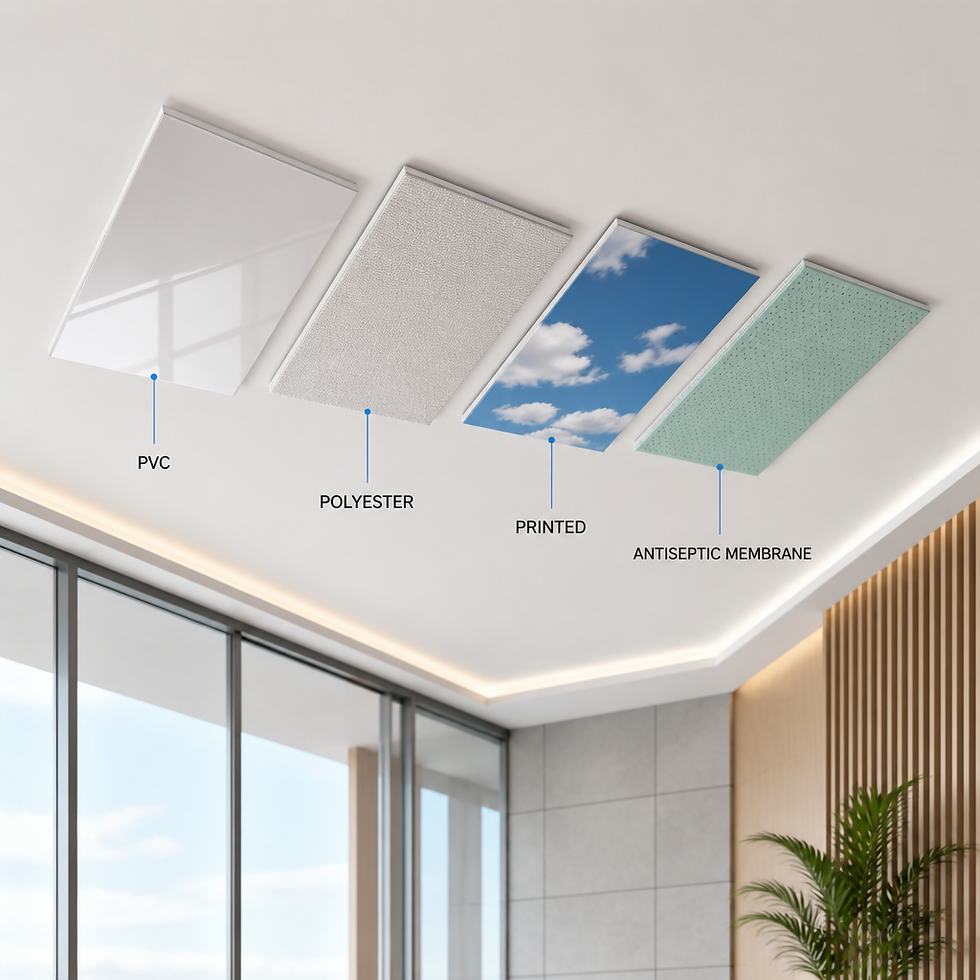
There are, of course, specification decisions to make. PVC-based membranes and polyester fabric systems do not behave identically. Heated-installation thermoplastic membranes offer excellent moisture resistance and a broad finish range. Cold-installed polyester systems can deliver exceptional strength, expansive spans and sharp digital print quality. The right choice depends on environment, scale, impact risk and visual intent.
When customisation is worth it - and when it is not
Not every project benefits from extensive bespoke work. If the ceiling layout is straightforward, programme pressure is severe and the design language is intentionally modular, a standardised panel solution may be entirely appropriate.
But where the interior is expected to carry brand identity, support premium user experience or resolve multiple performance requirements in one plane, customisation usually creates measurable value. It can reduce visual clutter, improve coordination with other services and deliver a more coherent spatial result. In commercial terms, that often means fewer compromises later in the project, when changes become expensive and disruptive.
The key is disciplined specification. Bespoke should never mean arbitrary. It should mean the panel has been engineered around the project’s actual architectural, lighting and operational demands.
Questions to resolve before specifying a custom panel
Before committing to a bespoke solution, it helps to define the non-negotiables. What should the panel do when viewed from below, from the room perimeter and when unlit? Is the priority feature lighting, general illumination or atmospheric backlighting? Does the ceiling need to absorb sound, resist humidity or conceal substantial services? How will the panel be maintained five years after completion?
These are not minor technicalities. They determine whether the finished result feels effortless or compromised. The most successful custom panel schemes are usually those developed collaboratively between designer, specialist manufacturer and delivery team, with mock-ups and light testing undertaken before the final specification is frozen.
For that reason, a consultative partner is often more valuable than a broad product range. Precision matters. So does the ability to translate a visual concept into a buildable ceiling system that performs as convincingly as it photographs.
Light panels can absolutely be customised, but the better question is whether they can be customised intelligently enough to serve the architecture. When they are, illumination stops being a fitting choice and becomes part of the spatial language itself.


Comments