
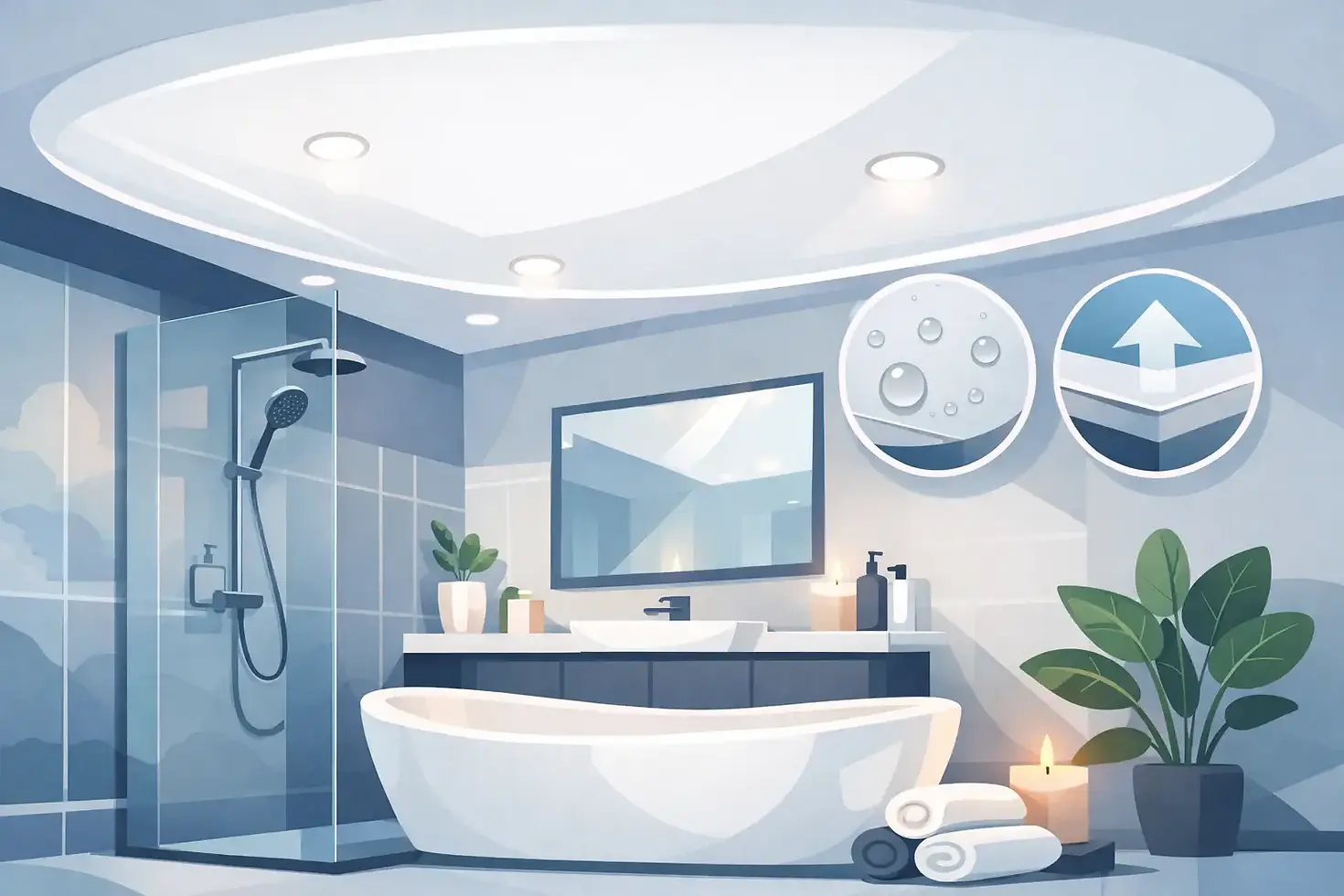
Is a Stretch Ceiling for Bathroom Worth It?
- NeviTec Stretch Ceiling

- Apr 9
- 6 min read
Bathrooms expose every weakness in a ceiling. Steam settles into corners, condensation highlights every uneven surface, and lighting often has to work harder in a compact space than anywhere else in the home. That is exactly why a stretch ceiling for bathroom design has become a serious specification choice rather than a decorative extra. In the right scheme, it solves practical issues while delivering a cleaner, sharper architectural finish.
For high-end residential projects, hospitality settings and wellness spaces, the ceiling is rarely just a background surface. It influences how light is distributed, how spacious the room feels and how refined the final result appears. In bathrooms especially, where moisture, maintenance and detailing matter, a stretch ceiling can outperform more conventional finishes.
Why a stretch ceiling for bathroom spaces makes sense
A bathroom ceiling has to cope with more than appearance. It needs to perform in a humid environment, remain stable over time and support a finish that still looks precise after years of use. Traditional plasterboard can work, but it is less forgiving when the substrate is poor, services need concealing or the design calls for integrated lighting.
A stretch ceiling introduces a tensioned membrane fixed to a perimeter track, creating a perfectly smooth surface beneath the existing soffit. That makes it particularly effective when the original ceiling is uneven, cracked or cluttered with pipework and cabling. Instead of battling with extensive preparation, the new finish is formed cleanly and accurately below.
Moisture resistance is one of the strongest arguments. In a well-designed bathroom, steam and humidity are constant. Materials that absorb moisture or show movement over time can quickly undermine the look of the room. Stretch systems are far better suited to that environment, provided the specification is correct and the installation is handled properly.
There is also a design advantage that standard ceilings struggle to match. A stretch membrane allows for controlled reflectivity, precise lighting integration and a level of visual consistency that suits premium interiors. In a compact en suite, that can help the room feel brighter and more generous. In a larger spa-style bathroom, it can support a calmer, more polished atmosphere.
What performance should you expect?
The main benefit is stability in demanding conditions. A properly specified stretch ceiling will not react to moisture in the same way painted plaster can. That means fewer worries about peeling finishes, visible movement or patchy discolouration caused by repeated steam exposure.
Maintenance is another strength. Bathroom surfaces need to be easy to keep looking presentable, particularly in guest suites, hotels and luxury rental settings where wear shows quickly. Stretch ceilings offer a neat, wipeable finish that helps preserve the visual standard of the room with less ongoing intervention.
That said, performance is not simply about the membrane itself. The surrounding design still matters. Ventilation, lighting positions, service access and substrate conditions all affect the long-term result. A stretch ceiling is not a substitute for poor building performance, but it is an excellent tool when used as part of a well-considered ceiling package.
PVC or polyester - which works better in a bathroom?
This depends on the brief. PVC stretch ceilings are often chosen where a crisp finish, strong moisture resistance and a wide range of visual effects are required. They are particularly effective in bathrooms because they handle humid conditions well and can produce anything from a subtle satin plane to a high-gloss reflective ceiling.
Polyester systems, installed cold rather than heat-activated, can also be appropriate depending on the project. They bring their own advantages, especially where installation constraints or finish preferences point that way. The key is not to treat all stretch products as interchangeable. Material selection should follow the room conditions, the visual intent and the technical demands of the scheme.
For specifiers, this is where specialist manufacturing matters. The best results come from systems designed around the project rather than forced into a generic product template. A bespoke approach gives more control over detailing, lighting cut-outs, perimeter treatment and the overall architectural fit.
Lighting is where the ceiling starts to work harder
Bathroom lighting is often compromised by the limitations of traditional ceiling construction. Downlights alone can create harsh shadows, while feature lighting is sometimes added too late to feel integrated. A stretch ceiling opens up more precise options.
Because the membrane can work with integrated LED solutions, the ceiling becomes part of the lighting design rather than merely the surface light fittings sit within. Soft perimeter glow, backlit zones and cleanly recessed fittings are all possible when planned from the outset. That can be especially valuable in bathrooms where layered lighting is essential - bright enough for practical use, but controlled enough to support a calm atmosphere.
Reflective finishes can amplify light and add depth, but they are not right for every scheme. In a minimalist powder room, a lacquered effect might create exactly the impact a designer wants. In a softer, natural material palette, a satin or matt finish may feel more balanced. The point is flexibility. The ceiling can be tuned to the mood of the room rather than left as a blank white default.
Design trade-offs worth knowing
A stretch ceiling is not the right answer simply because it is technically impressive. In some bathrooms, a more conventional finish may be sufficient. If the room is straightforward, the substrate is sound and there is no need to conceal services or integrate specialist lighting, the value of a stretch system may be more about refinement than necessity.
There is also the question of ceiling height. Although the system is slim, it still requires a void below the existing ceiling. In most cases this is modest and easily justified by the cleaner result, but in very tight spaces every millimetre matters. Early coordination avoids disappointment.
Design intent matters too. If the bathroom relies on expressive cornicing, highly textured surfaces or a heritage-style ceiling treatment, a tensioned membrane may not be the natural fit. Stretch systems excel when the brief calls for precision, calm surfaces, controlled light and contemporary detailing.
Where stretch ceilings add the most value
In premium bathrooms, value often comes from solving several problems at once. A stretch ceiling can hide an uneven soffit, support integrated lighting, improve visual uniformity and provide a moisture-resistant finish in a single system. That combination is difficult to match with traditional methods without introducing more trades, more time and more finishing risk.
They are particularly effective in spa bathrooms, hotel en suites, wellness facilities and high-specification residential refurbishments where the existing ceiling condition is less than ideal. They also suit projects where speed and cleanliness on site are important. Because the final visual result depends on controlled fabrication, much of the precision is built into the system before installation begins.
For architects and interior designers, that means greater confidence in the finished line and less reliance on wet trades delivering flawless ceilings under difficult site conditions. For contractors and developers, it can mean a more predictable route to a premium finish.
What to look for in a supplier
Not all stretch ceiling providers operate at the same level. In a bathroom, small detailing errors become obvious very quickly because the space is intimate and light reflects across every surface. Manufacturing quality, technical support and lighting integration are not secondary concerns - they are central to the result.
Look for a specialist that can advise on material selection, perimeter details, access requirements and lighting coordination from the beginning. Bespoke fabrication is especially important where the room includes awkward angles, niches, rooflights or custom illumination. A bathroom ceiling should feel designed, not adapted.
This is where a company such as NeviTec stands apart. When ceiling, lighting and surface performance are approached as one coordinated system, the result is more resolved architecturally and more dependable in use.
Is it worth specifying?
If the goal is a bathroom that looks sharper, handles humidity better and gives lighting a more architectural role, then yes - often decisively so. A stretch ceiling is not just an alternative finish. It is a way of elevating a technically demanding room with greater control over appearance and performance.
The strongest bathroom interiors do not leave the ceiling to chance. They treat it as part of the design language of the room, with the same attention given to finish, light and longevity as any other surface. When that matters, a stretch ceiling stops being a niche option and becomes a very intelligent one.
If you are shaping a bathroom where visual precision and technical reliability need to coexist, the ceiling deserves to be part of the conversation much earlier than most projects allow.


Comments